








Out of 547 Reviews
When you get injured in an accident, you need doctors to assess and treat your injuries. Part of that assessment often involves diagnosing the cause. Obviously, it is better evidence for us if the doctor says it was caused by trauma/your accident, but it can help insurance companies if the doctor says the injury is “degenerative.”
A degenerative injury is one that happens over time, usually from natural wear and tear. If a doctor says your injury was degenerative, it may be taken to mean it was preexisting, i.e., it was not caused by your accident. If insurance latches onto this argument, they may try to deny coverage for that injury or even deny your claim entirely, requiring us to overcome their claim with more evidence. These cases are often resolved by a jury.
For help with your case, call Wruck Paupore’s Indiana personal injury lawyers at (219) 322-1166 right away.
In a personal injury case, you can only file insurance claims and lawsuits for injuries that were caused by the accident at hand. Other injuries with outside causes are not covered.
An injury or condition is “degenerative” if it gets worse over time. Typically, this means that the injury was already there – it was a preexisting injury – that happens to be more severe and noticeable now.
In an injury claim, you cannot claim preexisting injuries. You can only claim damages for injuries that were new in this accident.
If you already had the injury, we have to draw a line between what was already there and what was new in this accident. You can still get damages for the extent that your injury got worse, just not the preexisting degenerative injury.
One common example is back injuries. You may have degenerative disc injuries or other tightness and pain in your back over time. If the doctors cannot separate that preexisting, degenerative condition from the pain and injury in your accident, we may have trouble claiming damages for the back injury.
Other common degenerative conditions that come up in injury cases are arthritis, joint pain, prior broken bones, sprains, and other musculoskeletal conditions.
Insurance companies love to hear that an injury was deemed degenerative by a doctor, because it means they do not have to cover it – at least in part.
Insurance companies often go too far and say that all degenerative injuries are preexisting, but this is not always true. Sometimes an accident causes a degenerative injury, and sometimes it makes a preexisting degenerative injury worse. Both of those issues should still be covered.
Just because you had a preexisting or degenerative condition doesn’t mean the insurance company isn’t responsible for how much worse it got in the present accident.
We need to determine what condition you were in before the accident. For example, if you had a “bad back” and it caused you everyday pain rated at a 2 out of 10 and caused you to miss one workday a year, that is a baseline “normal” we can work from.
If the accident made your injury worse, we can claim damages for the extent to which it got worse. For example, if you were in a car accident and your back injury is now a daily 9 out of 10 and you miss 2 days of work a week, it is clear the accident made it worse.
Insurance companies have to pay for the injury to the extent it was made worse (i.e., an extra 103 days of missed work per year and an increase of 7 out of 10 per day for pain).
Often, to pin down what was there before and what was new after this accident, we need to look at new and old medical records.
For example, past records might show you had a degenerative disc disease in your back and explain how serious it was.
Sometimes the assessment is just wrong: you had no prior injuries or degenerative conditions, and all of your injuries are from this accident.
If all of your prior medical records say nothing of a previous degenerative condition, it is hard for the defense to claim you already had one before the accident.
If the insurance company tries to say you have a degenerative condition, we can look at what that condition would have meant for your physical fitness and abilities before the accident. If they say, for example, that you had a back injury, but you never missed a day of work or complained of a “bad back,” we can have doctors, and potentially family and employers, testify to that fact.
Often, when a doctor diagnoses a condition as degenerative, it is because they made a mistake or did not have enough evidence to link the condition to the accident you were in. We can often seek another exam from a new doctor to finish connecting the dots the other doctor missed.
No. The insurance company will determine whether they want to settle or agree to pay, but we can file a lawsuit alongside your insurance claim. If the insurance company will not settle, then we can leave it to the jury to determine whether your injury was degenerative or from the accident.
We can present them with multiple doctors’ reports, your testimony, and testimony from others in your life to show that the injury was new and not degenerative.
Insurance companies usually do not get this argument out of thin air; they usually only make these claims if a doctor’s report said the injury was degenerative first. Then, they latch onto that argument.
If they are successful in claiming it was degenerative, it would mean it wasn’t caused by this accident. Then, they would not have to pay for it.
Some injuries from an accident will get worse over time. This may make them “degenerative injuries,” but the cause is still the accident at hand.
You can get damages for all effects of an injury, including an injury that will worsen over time, as long as you can prove the defendant caused the initial injury.
For a free review of your potential case, call Wruck Paupore’s Indianapolis, IN personal injury lawyers at (219) 322-1166.
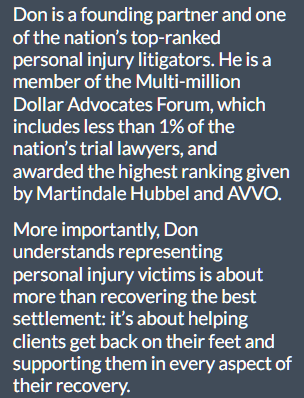
Don is a founding partner and one of the nation’s top-ranked personal injury litigators. He is a member of the Multi-million Dollar Advocates Forum, which includes less than 1% of the nation’s trial lawyers, and awarded the highest ranking given by Martindale Hubbel and AVVO.
More importantly, Don understands representing personal injury victims is about more than recovering the best settlement: it’s about helping clients get back on their feet and supporting them in every aspect of their recovery.
In nearly all cases, our clients seek compensation from the wrongdoer’s insurance company. Before forming Wruck Paupore, Jason worked for a prominent law firm representing some of the world’s largest insurers. This experience gives Jason a deep understanding of the insurance industry and the strategies it uses to pay injury victims as little as possible.
Jason -- and our entire team -- put this inside knowledge to work to force insurance companies to pay what is actually owed. Often, we use the insurance company’s own tactics against them as we fight for the full compensation our client deserves.

For more than four decades, Keith has been fighting for injury victims. During that time, he’s watched the insurance industry change, with insurers now more interested in protecting their stock price than treating injury victims fairly.
Since the beginning, Keith has put people first. From his childhood in Gary, Indiana during the 1960’s and working his way through law school, Keith has risen to become one of the Midwest’s most respected trial lawyers. He has never forgotten that being a lawyer is about helping people -- and seeing injury victims through struggles in a way that could change their lives forever.
Over the decades, Keith, Don and Jason have fought relentlessly for clients, even when other lawyers have said the case was impossible to win.






















Contact Us:
Wruck Paupore P.C.
Injury Lawyers
275 Joliet St. Suite #250
Dyer, IN 46311

© 2026
Terms of Service | Privacy Policy | Resources | Blog | Sitemap

© 2022 Wruck Paupore PC
Terms of Service | Privacy Policy