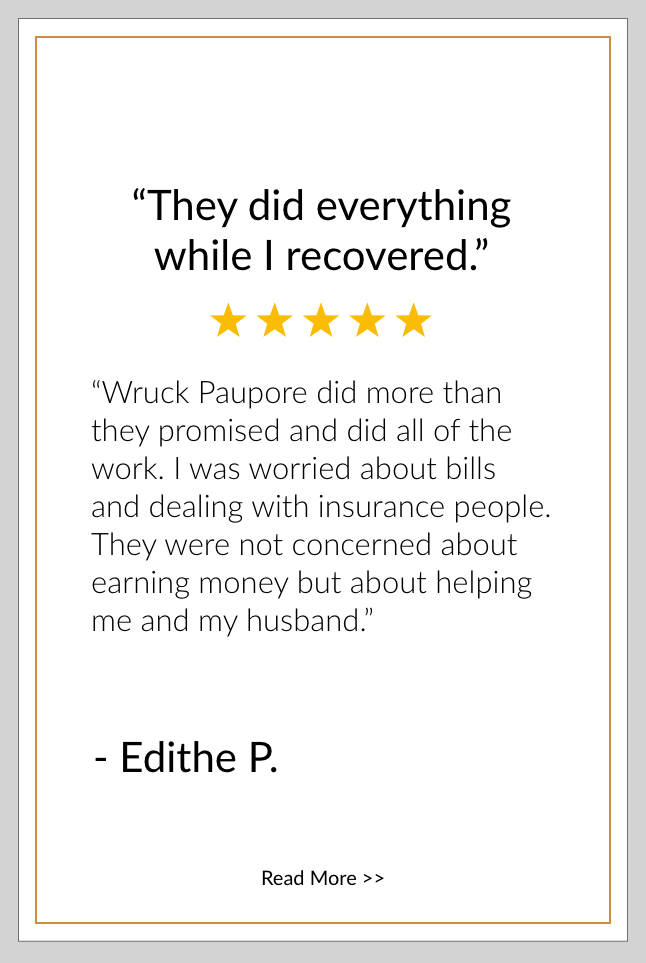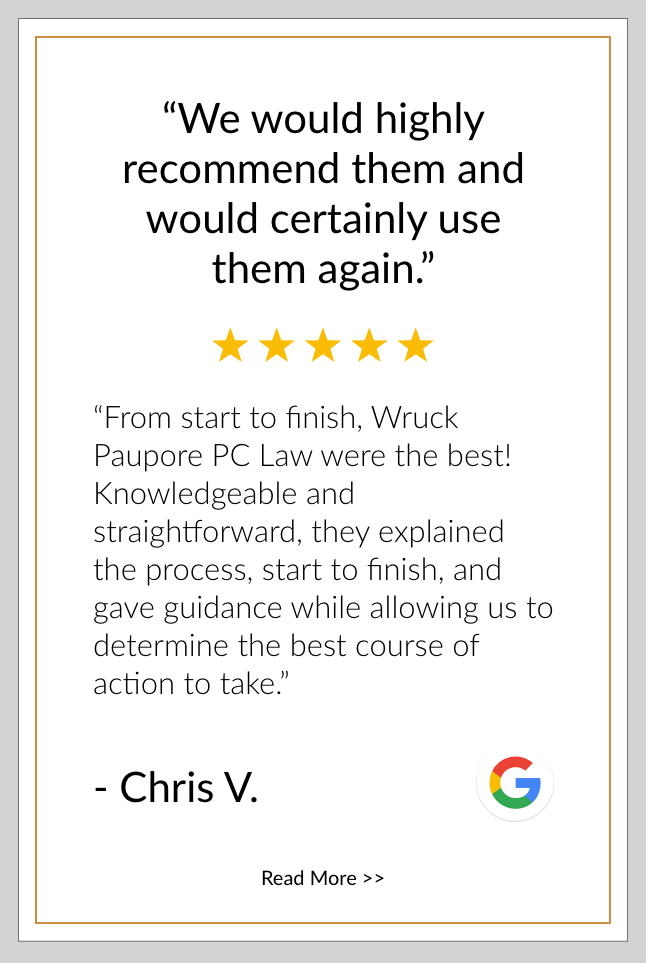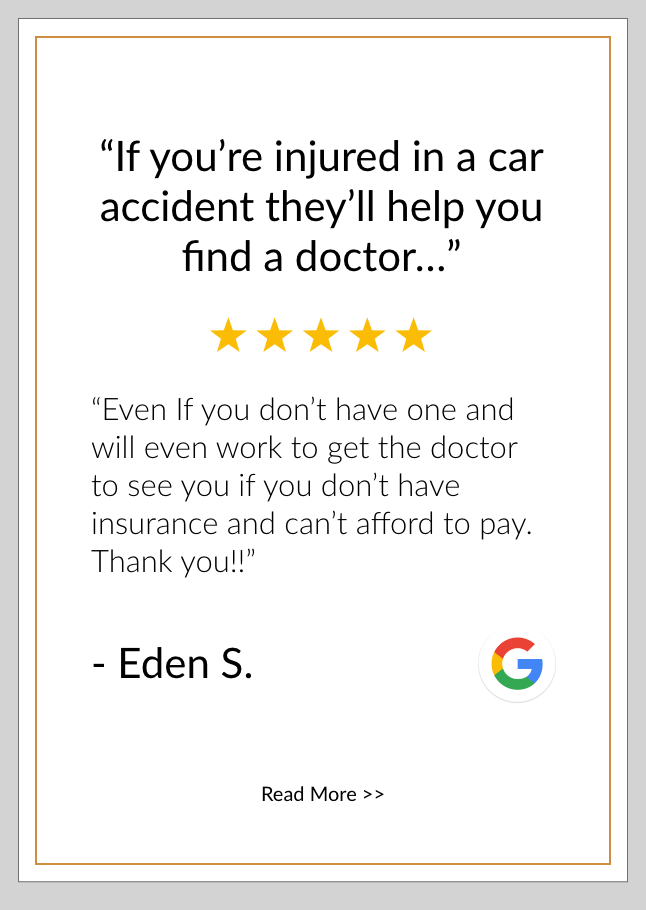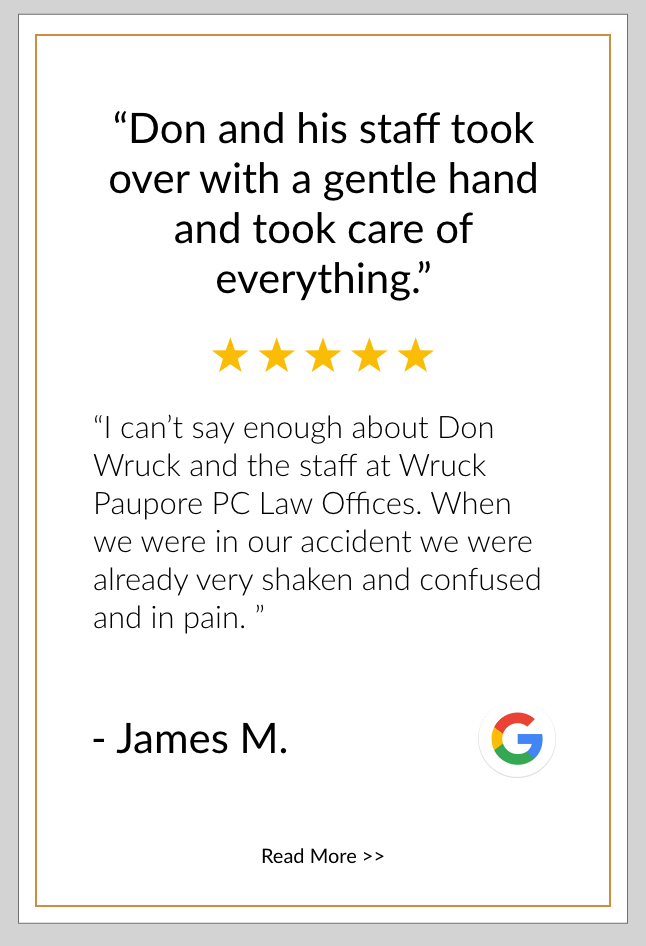








Out of 547 Reviews
Pedestrians are only supposed to cross roads in the crosswalk. But not every road has crosswalks, and poor road planning may mean there is no practical place to cross without walking far out of your way. So what happens if a pedestrian gets hit between crosswalks?
There are plenty of accidents outside of crosswalks where the driver would obviously be at fault, such as if they clipped a pedestrian who was walking on a sidewalk or they jumped the curb and crashed into a pedestrian on the side of the road. Otherwise, the case needs to be investigated on a case-by-case basis, and crossing between marked crosswalks may be perfectly legal.
For help with your pedestrian accident case, call the Indianapolis pedestrian accident lawyers at Wruck Paupore at (219) 322-1166.
Crosswalks are designed as places where pedestrians can cross safely. The law requires drivers to yield to pedestrians in crosswalks, and marked crosswalks and signs/signals help keep pedestrians safe. But is it really the only place it is legal to cross the road?
Under I.C. § 9-21-17-4, all crosswalks are supposed to be marked. On top of that, § 9-21-17-9 makes it illegal to cross between marked crosswalks, and § 9-21-17-7 says to yield to cars on the roadway.
That being said, crossing at a crosswalk is not always possible or practical. Sometimes on rural or suburban roads, there is no crosswalk – so what are you supposed to do? Just never cross the road?
While I.C. § 9-21-17-7 says you must yield to cars when crossing outside of a crosswalk, it also talks about the possibility of an “unmarked crosswalk.” Crossing at an intersection that is designed for pedestrians to cross or has signals is perfectly legal.
If crossing at any other location, you should yield to cars on the road and cross when safe.
Even though you are supposed to yield to drivers on the road when crossing between crosswalks, you may still have a case if you were hit between crosswalks.
If you were following the law when you entered the street, then you were not doing anything wrong. Accidents in the middle of the street often happen because drivers sped around a blind corner or were speeding unreasonably when the pedestrian was already in the street.
If you looked both ways, yielded to any cars on the road, then you began crossing legally, you should not be held partially at fault when the driver did something wrong after that.
Indiana works on a comparative negligence system, meaning that just because you did something wrong doesn’t mean the case was all your fault. Courts have to weigh your degree of fault against the defendant’s degree of fault when analyzing accident cases.
If you are 50% at fault or less, you can still recover reduced damages. You are only blocked from suing if you are over 50% at fault.
There are plenty of places other than marked crosswalks where a crash might occur, and many of them are still the driver’s fault.
Unmarked crosswalks have the same rules as marked crosswalks, so pedestrians should be allowed to cross when they have a proper signal.
As mentioned, it is illegal to cross between crosswalks, but if you yield to cars on the road, then anything that happens after that is assessed separately. It takes weighing the driver’s fault against your own fault to determine overall fault.
If you are hit while on the sidewalk, then that is likely the driver’s fault. Cars should not be so close to the sidewalk that they clip drivers, and they should never leave the roadway and hop the curb onto the sidewalk.
Similarly to sidewalks, pedestrian walkways are for pedestrians, not cars. However, some are shared with bikes, and it is important to stay to the right and out of the way of cyclists, or else you could be hit by a bike rather than a car.
In the end, drivers would usually be at fault for these crashes, but cyclists might not be if you got in their way because of inattention.
Parking lots are treated much like roads, but they are not roads. Because of this, the rules may be different, and we might need to look more at who was acting reasonably rather than whether any laws were explicitly broken.
In some cases, the property owner might be at fault for dangerous lighting, blind corners, poor signage, and dangerous designs.
In some states, drivers need to yield to pedestrians anywhere, while in others, this rule only applies in crosswalks.
As long as the pedestrian was following all signs and pedestrian signals, drivers have to yield to them in crosswalks. Drivers do not need to yield to allow pedestrians to cross roadways outside of a crosswalk but they do need to yield to pedestrians already in the street. They cannot just hit you.
Most accidents in crosswalks happen for these reasons:
In all of these situations, the driver’s actions are illegal.
Typically, our pedestrian accident lawyers do both. We can explain the process for filing your claim in a free case evaluation and fight to maximize your damages.
For a free case evaluation, call the Fort Wayne, IN pedestrian accident lawyers at Wruck Paupore at (219) 322-1166.
Don is a founding partner and one of the nation’s top-ranked personal injury litigators. He is a member of the Multi-million Dollar Advocates Forum, which includes less than 1% of the nation’s trial lawyers, and awarded the highest ranking given by Martindale Hubbel and AVVO.
More importantly, Don understands representing personal injury victims is about more than recovering the best settlement: it’s about helping clients get back on their feet and supporting them in every aspect of their recovery.
In nearly all cases, our clients seek compensation from the wrongdoer’s insurance company. Before forming Wruck Paupore, Jason worked for a prominent law firm representing some of the world’s largest insurers. This experience gives Jason a deep understanding of the insurance industry and the strategies it uses to pay injury victims as little as possible.
Jason -- and our entire team -- put this inside knowledge to work to force insurance companies to pay what is actually owed. Often, we use the insurance company’s own tactics against them as we fight for the full compensation our client deserves.
For more than four decades, Keith has been fighting for injury victims. During that time, he’s watched the insurance industry change, with insurers now more interested in protecting their stock price than treating injury victims fairly.
Since the beginning, Keith has put people first. From his childhood in Gary, Indiana during the 1960’s and working his way through law school, Keith has risen to become one of the Midwest’s most respected trial lawyers. He has never forgotten that being a lawyer is about helping people -- and seeing injury victims through struggles in a way that could change their lives forever.
Over the decades, Keith, Don and Jason have fought relentlessly for clients, even when other lawyers have said the case was impossible to win.














Contact Us:
Wruck Paupore P.C.
Injury Lawyers
275 Joliet St. Suite #250
Dyer, IN 46311

© 2026
Terms of Service | Privacy Policy | Resources | Blog | Sitemap

© 2022 Wruck Paupore PC
Terms of Service | Privacy Policy