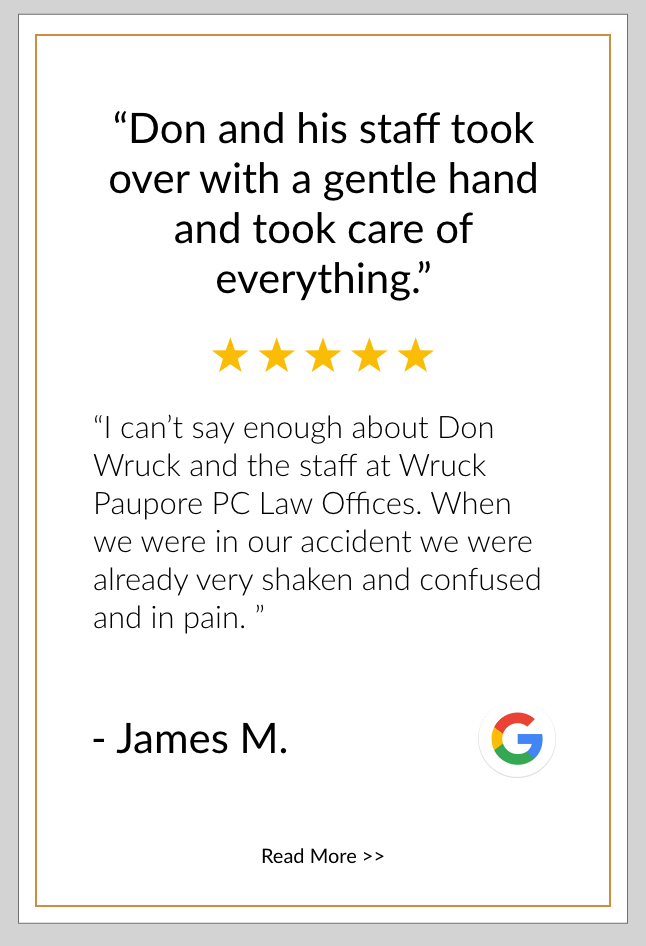








Out of 547 Reviews
Properly reporting an accident and getting medical treatment is vital after an injury. However, reporting requirements might not be what you expect, and delays may or may not affect your case.
If you are required to call 911 and report an accident – such as a car accident – you must do so immediately. Delays will hurt your case because it makes it seem like the accident wasn’t that bad or you were afraid of reporting because you were at fault. In other cases, calling 911 isn’t necessary unless you need an ambulance. If you had other ways of getting to a hospital, it’s more important that you get immediate medical care than that you called 911 to get it.
Call Wruck Paupore’s Indiana personal injury lawyers for help on your case today at (219) 322-1166.
In most cases, there is no legal requirement to call 911. Even so, failing to do so when the conditions call for it, even without a legal requirement, might still hurt your case.
All car accidents involving injury or death need to be reported immediately. This means calling 911 as soon as you are able to to request police and, if needed, an ambulance.
In most other accident cases, there is no need to call 911 to report the accident to the police. For example, there is no reporting requirement for a slip and fall or a product injury case.
The only reason to call 911 in these cases would be if you need an ambulance.
If you do need medical care, but you delay treatment, there are a few ways this court hurt your case. Our Indianapolis personal injury lawyers can make arguments to mitigate the effects of delays, but getting immediate medical care after any accident may be the best way to avoid these potential negatives.
If you wait to get medical care, it can be harder to claim the injury was actually serious. If your injuries are serious, juries expect that you would need medical care right away.
There may be reasons to wait – such as the fact that adrenaline was masking the injuries or you did not notice whiplash until the next morning – but juries do not always understand this.
If you get medical care for an injury days after the accident, there is less proof that the injuries came from the accident. If you have other evidence of the harm – such as photos of the injuries at the scene of an accident – that will fill in the gaps.
If you cannot prove the injury came from this accident, you cannot prove the defendant’s fault in causing it.
Without documentation through medical records, you might not be able to prove the injury happened at all. If it was already healed by the time you sought treatment, the doctors might not document it, and the defendant might not pay you for it.
Your healing process or future outcome might be worse if you don’t get proper treatment. In many cases, if the injury was made worse because of something you did, the defendant doesn’t have to pay for that increase in harm.
What might have been treated and healed without scarring in the first hour or first day after an injury might be a serious problem hours or days later.
If you have another way of getting to a hospital for treatment, you might not need to call 911. While the EMTs can treat you in the ambulance on the way to the hospital, alternate transportation might get you prompt treatment anyway.
If there are faster ways to get medical care – such as having a loved one drive you to a nearby hospital – that would be the most reasonable way to get medical care. The fact that you did not wait longer to call 911 and get an ambulance to you should not hurt your case at all.
It is important to document all injuries, and the best way to do this is with EMTs or hospital staff examining you. However, sometimes injuries are not noticeable immediately. For example, whiplash might not be noticed until the next day, after a night’s rest.
If a reasonable person in your situation would have thought, “I should get this checked out,” then it is important to seek medical care – whether by calling an ambulance or going to the hospital.
Sometimes it is worth getting examined after an accident, even when there are no immediate signs of injury, especially with head injuries and potential internal bleeding. Otherwise, it might be reasonable to wait until signs or symptoms of injury appear.
There are ways to report a car accident if, for some reason, you did not do so right away. However, it is best to have the police come to the scene and investigate right away rather than performing a secondhand investigation days or weeks later.
Your evidence might be worse if you waited to call 911 or skipped it entirely, but that doesn’t mean your case is over. Especially if calling 911 didn’t seem reasonable at the time, this can be explained to the jury.
However, car insurance claims might be more difficult without a police report.
In most cases, medical treatment should happen at a hospital, not another care institution. The EMTs can help with first aid and stabilization, but if they recommend that you go to the hospital, do not decline care.
Doctors’ offices and urgent care clinics might be able to turn you away because your injuries are too severe or they are not set up to bill insurance companies. Hospitals, however, must treat you if you go there.
For a free case review, call Wruck Paupore’s South Bend, IN personal injury lawyers at (219) 322-1166.
Don is a founding partner and one of the nation’s top-ranked personal injury litigators. He is a member of the Multi-million Dollar Advocates Forum, which includes less than 1% of the nation’s trial lawyers, and awarded the highest ranking given by Martindale Hubbel and AVVO.
More importantly, Don understands representing personal injury victims is about more than recovering the best settlement: it’s about helping clients get back on their feet and supporting them in every aspect of their recovery.
In nearly all cases, our clients seek compensation from the wrongdoer’s insurance company. Before forming Wruck Paupore, Jason worked for a prominent law firm representing some of the world’s largest insurers. This experience gives Jason a deep understanding of the insurance industry and the strategies it uses to pay injury victims as little as possible.
Jason -- and our entire team -- put this inside knowledge to work to force insurance companies to pay what is actually owed. Often, we use the insurance company’s own tactics against them as we fight for the full compensation our client deserves.
For more than four decades, Keith has been fighting for injury victims. During that time, he’s watched the insurance industry change, with insurers now more interested in protecting their stock price than treating injury victims fairly.
Since the beginning, Keith has put people first. From his childhood in Gary, Indiana during the 1960’s and working his way through law school, Keith has risen to become one of the Midwest’s most respected trial lawyers. He has never forgotten that being a lawyer is about helping people -- and seeing injury victims through struggles in a way that could change their lives forever.
Over the decades, Keith, Don and Jason have fought relentlessly for clients, even when other lawyers have said the case was impossible to win.















Contact Us:
Wruck Paupore P.C.
Injury Lawyers
275 Joliet St. Suite #250
Dyer, IN 46311

© 2026
Terms of Service | Privacy Policy | Resources | Blog | Sitemap

© 2022 Wruck Paupore PC
Terms of Service | Privacy Policy